

Iran Attacks US Airbases – The Strike on Al Udeid and Its Global Shockwaves
In a dramatic escalation of hostilities in the Middle East, Iran attacks US airbases, launching a barrage of missiles on the Al Udeid Air Base in Qatar; home to the largest American military installation in the region. This bold strike, carried out on June 23, 2025, followed U.S. airstrikes on Iranian nuclear facilities two days earlier. Though the attack caused no fatalities, it has sent shockwaves through the region and the world, reigniting fears of full-scale military conflict between Tehran and Washington.
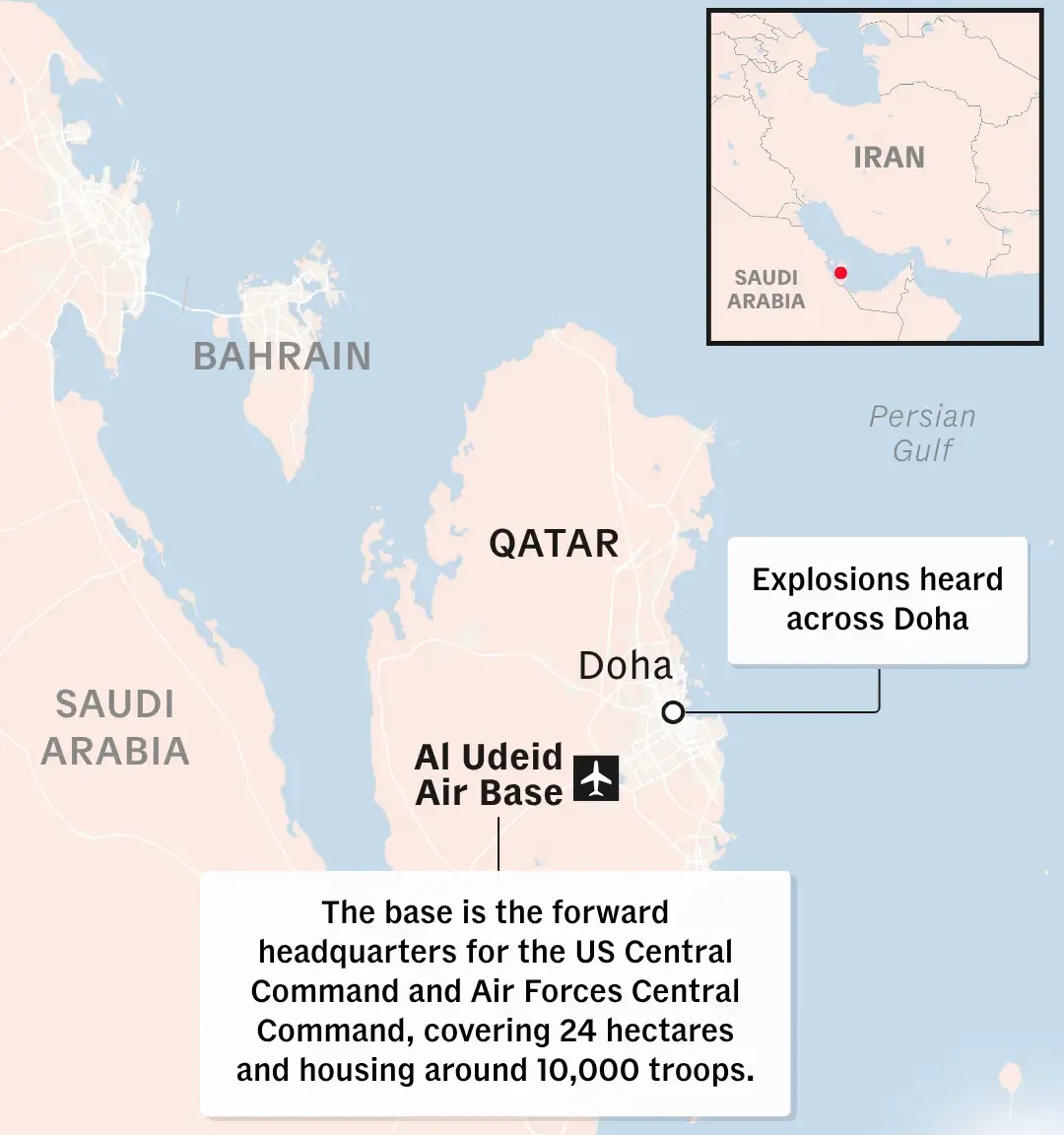
The Strike: A Missile Assault on Al Udeid Air Base
Iran’s Islamic Revolutionary Guard Corps (IRGC) confirmed it had launched short- and medium-range ballistic missiles in what it dubbed “Operation Annunciation of Victory.” The Al Udeid Air Base, located just southwest of Doha and shared by the Qatar Air Force Base, was the primary target. The missiles were fired from Iranian territory and intercepted over Qatari airspace by American and Qatari defense systems.
| Key Facts | Details |
| Attack Date | June 23, 2025 |
| Target | Al Udeid Air Base, Qatar |
| Responsible Party | Iran’s Islamic Revolutionary Guard Corps (IRGC) |
| Missile Types Used | Short-range and medium-range ballistic missiles |
| US Casualties Reported | None |
| Qatar’s Response | Air defense intercepted missiles; strongly condemned the strike |
| US Response | Forces went into shelter-in-place mode; monitoring escalation |
Iran claimed the attack was a direct retaliation for the U.S. strikes on its Fordow, Natanz, and Arak nuclear facilities, which were hit in Operation Midnight Hammer over the weekend. Iranian state television called the counterstrike “a strong message to the enemy” and signaled that more attacks could follow if “aggression” continued.
Qatar’s Interception and Diplomatic Fallout
Qatar’s Ministry of Defense swiftly issued a statement saying its air defenses had successfully intercepted all incoming missiles. The Al Udeid Air Base suffered no reported damage. Qatar condemned the Iranian action as a “flagrant violation of Qatari sovereignty, airspace, and international law,” echoing similar statements from Saudi Arabia, the United Arab Emirates, and the Gulf Cooperation Council (GCC).
“The State of Qatar reserves the right to respond in kind to this illegal and dangerous act,” said a Qatari foreign ministry spokesperson.
The Qatar air force base, though technically under Qatari control, houses approximately 10,000 U.S. military personnel and serves as the forward headquarters of CENTCOM (U.S. Central Command). Qatar’s airspace was temporarily closed, and commercial flights to and from Doha and Dubai were rerouted or grounded.
Al Udeid Air Base: Why It Matters
The Al Udeid Air Base location makes it one of the most strategic U.S. military assets outside the continental United States. Built in the 1990s and expanded post-9/11, the base now features state-of-the-art command and control centers, a 13,000-foot runway, and extensive lodging and dormitory facilities for deployed forces.
Overview: Al Udeid Air Base in Qatar
| Feature | Details |
| Location | Southwest of Doha, Qatar |
| Functions | Air operations, intelligence, logistics, drone command, CENTCOM HQ |
| Runway | 13,000 feet, capable of handling heavy bombers |
| Personnel | Approx. 10,000 U.S. troops, plus Qatari Air Force presence |
| Living Quarters | Includes Al Udeid dorms, BPC dorms, and officer housing blocks |
| Mapping Resources | Searchable via terms like al udeid air base qatar map, base map |
| Support Facilities | Hospitals, recreation, mess halls, intelligence centers |
The Al Udeid lodging and Al Udeid air base living conditions are typically regarded as more advanced than most forward-deployed installations, which underscores its long-term strategic importance for the U.S. in the Gulf region.
Strategic Timing and Military Readiness
According to diplomatic sources, U.S. and Qatari officials had convened several high-level meetings before the attack, anticipating Iranian retaliation. The U.S. Embassy in Doha had already issued shelter-in-place orders to American civilians, and Qatar had closed its airspace hours before the strike.
Though Iran framed the attack as retaliation, analysts believe it was highly calculated and largely symbolic. A senior Pentagon official stated the attack may have been approved through backchannels to avoid escalation, especially considering the limited scope and the successful interception of all missiles.
Ziad Daoud, chief economist at Bloomberg MENA: “This retaliation was more theater than war. Qatar’s decision to shut its airspace, the early warnings from U.S. intelligence, and the lack of casualties all indicate forewarning and containment.”
Reaction Across the Region and in Washington
Middle East capitals quickly responded. Saudi Arabia and the United Arab Emirates both condemned Iran’s actions. Bahrain, which hosts the U.S. Navy’s 5th Fleet, also temporarily closed its airspace after sirens sounded in Manama.
In Washington, Speaker Mike Johnson said it’s up to the President (Donald Trump) to decide if the U.S. should retaliate, while House Minority Leader Hakeem Jeffries announced a classified congressional briefing for Tuesday afternoon.
“The administration bears the burden of proving that its actions have neutralized the threat while ensuring we don’t slide into another prolonged Middle East war,” Jeffries wrote.
Aftermath of Iran’s Attack on Al Udeid – Military Response, Infrastructure, and Regional Stakes
Immediate U.S. Military Response to Iran’s Attack on Al Udeid Air Base
In the tense hours following the strike in which Iran attacks US airbases, particularly the Al Udeid Air Base in Qatar, the U.S. military moved swiftly into containment and readiness posture. Though no casualties were reported, the strike was treated as a serious escalation with the potential to ignite broader conflict.
CENTCOM, headquartered at Al Udeid, immediately shifted operations into a “shelter-in-place” status for its 10,000+ personnel. U.S. Air Force bombers, refueling aircraft, and intelligence systems were secured, and defensive systems remained at heightened alert, including Patriot missile batteries and THAAD (Terminal High Altitude Area Defense) platforms deployed in the region.
A Department of Defense (DoD) official confirmed that while retaliation was being considered, no immediate kinetic response would be initiated. Instead, the focus would remain on:
- Ensuring the safety of U.S. and coalition personnel.
- Monitoring for additional threats from Iran or its regional proxies.
- Maintaining operational control across the Gulf.
“The Iranian attack may have been designed more to send a message than inflict real damage,” said a senior Pentagon advisor. “But it will not be tolerated if it continues.”
Iran’s Strategy: Symbolism Over Substance?
Analysts and intelligence agencies suggest that this round of missile fire by Tehran, despite its bold headlines, was likely calibrated to avoid casualties and provoke without triggering total war. This aligns with Iran’s long-standing doctrine of asymmetric warfare, where psychological and symbolic victories matter as much as physical damage.
According to intelligence intercepts shared with media, Iran’s planning included:
- Avoiding targets with high likelihood of causing American deaths.
- Launching from multiple mobile platforms to confuse radar systems.
- Timing the strike during a high-alert window, ensuring interception.
“Iran attacks US airbases, but with the precision of a chess move, not a brawl,” said regional expert Dr. Anisa Faruqi from Georgetown University. “They’ve sent a signal; now they wait.”
Infrastructure of Al Udeid Air Base: Strategic Design and Defense Capabilities
Given its central role in U.S. operations, Al Udeid Air Base is fortified with cutting-edge surveillance, radar, and missile defense systems. The base’s facilities are considered superior even to many NATO-aligned installations.
Key Facilities at Al Udeid Air Base
| Component | Details |
| Runways | Two, each 13,000+ feet, capable of handling B-52 bombers |
| Hardened Aircraft Shelters | Reinforced to withstand missile strikes; contain fighter jets and drones |
| Command Centers | Hosts CENTCOM Forward HQ, ISR units, and air traffic control |
| Defensive Systems | Includes Patriot, THAAD, and short-range interceptors |
| Living Quarters | Al Udeid dorms are modular, climate-controlled, and fully serviced |
| Dining & Logistics | Large-scale mess halls, fuel depots, maintenance hangars |
The Al Udeid air base dorms, including the BPC dorms, are designed to house long-term rotational troops with amenities such as fitness centers, morale lounges, and communication terminals. There are also upgraded officer housing units and centralized medical clinics.
“From al udeid base map reviews to recent drone footage, the facility appears more like a hardened fortress than a vulnerable outpost,” noted Lt. Cmdr. James Holden, a retired USAF logistics expert.
Al Udeid’s Location and Regional Relevance
Al Udeid Air Base Location:
- Coordinates: 25.117° N, 51.317° E
- Distance from Doha: ~30 kilometers southwest
- Adjacent Facility: Qatar Emiri Air Force Base
- Mapped as: “Map of Al Udeid Air Base Qatar” on NATO and CENTCOM infrastructure charts
The al udeid air base qatar map shows its strategic proximity to the Strait of Hormuz, the most important oil chokepoint in the world. From Al Udeid, U.S. forces can launch missions across Iraq, Syria, the Red Sea, and into South Asia. It is a central hub for U.S. surveillance drones, aerial refueling, and strike aircraft.
“This base isn’t just a runway; it’s a control tower for an entire hemisphere,” said defense analyst Peter Bergen.
Fallout Across the Gulf: Airspace Shutdown and Regional Tensions
As the news that Iran attacks US airbases spread, regional allies scrambled to secure their borders and airspaces.
Airspace Disruptions
| Country | Action Taken |
| Qatar | Full airspace closure, redirected all commercial flights |
| UAE | Partial airspace closure, grounded international arrivals into Dubai |
| Bahrain | Temporarily suspended flights and issued air raid alerts |
The closures were precautionary and lifted within 12–18 hours, but the incident served as a reminder of how fragile Gulf aviation corridors remain in times of conflict. Global airlines including Emirates, Qatar Airways, and British Airways issued travel advisories.
Gulf Allies Condemn Iran’s Move
From Riyadh to Manama, condemnation of Iran’s missile strike was swift and severe.
- Saudi Arabia: Called it “a reckless act undermining regional peace.”
- UAE: Stated it was “a flagrant violation of Qatari sovereignty.”
- GCC Secretary-General: Warned of “serious consequences” if Iran repeated the provocation.
Notably, Qatar, despite its historically warm ties with Tehran, did not defend Iran’s action. Instead, it stressed sovereignty and international law, signaling that even traditional diplomatic bridges may be strained.
Energy Markets and Economic Shockwaves
Despite the high drama, oil prices plummeted by nearly 4%, surprising many observers. Why? Because the strike did not target energy infrastructure, and markets viewed the attack as symbolic rather than the start of full-scale war.
| Commodity | Price Drop | Reason |
| Brent Crude | -3.8% | No disruption to oil terminals |
| WTI Crude | -4.1% | Anticipated retaliation seen as mild |
| Aviation Fuel | -2.9% | Airspace shutdown seen as temporary |
“If this is all Iran does, markets can breathe easy for now,” said economist Ziad Daoud.
As Iran’s attack on US airbases; especially Al Udeid, enters the history books as a bold but carefully calculated military move, the region holds its breath. While no lives were lost, the symbolism and geopolitical shockwaves cannot be overstated. What happens next, retaliation or restraint, will shape not only U.S.-Iran relations but the future of military presence in the Gulf.
Iran Attacks US Airbases: A Pattern of Escalation
While the June 23, 2025, missile attack on Al Udeid Air Base marks a major flashpoint in current U.S.-Iran tensions, it is not the first time Iran has targeted American military installations in the region. The action fits into a broader history of asymmetric retaliation that has defined Iran’s military strategy for decades.
Timeline of Iran’s Strikes on U.S. Bases and Interests
| Date | Event | Location | Result |
| Jan 8, 2020 | Ballistic missile strike on Al Asad Air Base | Iraq | 100+ U.S. troops suffered traumatic brain injuries |
| Apr 14, 2022 | Drone attack intercepted en route to U.S. consulate | Erbil, Iraq | No casualties; blamed on Iranian proxy groups |
| Dec 2023 | Rocket strike on Green Zone | Baghdad, Iraq | Limited damage; blamed on IRGC-backed militias |
| Jun 23, 2025 | Ballistic missile strike on Al Udeid Air Base | Qatar | No casualties; missiles intercepted successfully |
These attacks demonstrate Iran’s strategic balancing act, retaliating against U.S. assets without triggering overwhelming American military reprisals. Al Udeid had never been directly hit until now, marking a significant escalation in both target and message.
“This is not an accident, the choice of Al Udeid, the largest U.S. base in the Middle East, was intentional. Iran wanted a headline without creating a funeral,” said Gen. Mark Carleton-Smith, former British Army Chief of General Staff.
Inside Al Udeid Air Base: Core of U.S. Power Projection
Understanding why Iran selected Al Udeid Air Base requires grasping its strategic value. Located southwest of Doha, this air base is home to the largest U.S. military installation in the Middle East, serving as a central node for surveillance, command operations, and air superiority.
Current U.S. and Coalition Deployments at Al Udeid
| Unit/Division | Primary Role |
| U.S. Air Forces Central Command | Oversees operations across 20 countries in the CENTCOM AOR |
| 379th Air Expeditionary Wing | Hosts over 100 aircraft, including B-52s, C-17s, and KC-135s |
| 609th Air Operations Center | Real-time battlefield data and command coordination |
| Coalition Air Force Transition Team | Supports training and liaison efforts with regional partners |
U.S. forces at Al Udeid are not just stationed; they operate in a rotating tempo. Missions launch daily into:
- Iraq and Syria (anti-ISIS operations)
- Red Sea and Gulf of Oman (freedom of navigation patrols)
- Southwest Asia (reconnaissance and deterrence flights)
It’s no exaggeration to say that if Iran’s goal was to shake the U.S. command center in the region, Al Udeid was its most potent symbolic target.
Living Conditions at Al Udeid: Strength and Vulnerability
Despite its strategic role, Al Udeid Air Base living conditions have long drawn mixed reviews from service members. The facility is a blend of high-tech infrastructure and minimalistic comfort, reflecting its rapid expansion post-9/11.
Snapshot of Life Inside Al Udeid
- Housing: Airmen are housed in al udeid dorms, including BPC dorms (Blatchford-Preston Complex), featuring private rooms, shared baths, and WiFi.
- Dining: Two major DFACs (Dining Facilities) provide 24/7 service.
- Recreation: Gyms, a movie theater, chapel, coffee shops, and USO facilities.
- Environment: Harsh desert conditions with 110°F+ summers and occasional dust storms.
The al udeid air base lodging is praised for its security and internet access, but criticized for repetitive food options and isolation. Google searches for “al udeid air base map” and “map of al udeid air base qatar” have spiked since the attack, showing growing public interest in the facility’s layout and vulnerabilities.
“It’s like living on a giant airstrip surrounded by sand and satellites,” joked one USAF sergeant. “We’re safe, but there’s no such thing as ‘away from it all’ here.”
Iran’s Motive and Message: Strategic Deterrence or Desperation?
Iran’s rationale in attacking US airbases is deeply rooted in a combination of strategic deterrence, nationalistic messaging, and geopolitical bargaining. Officials in Tehran claim the Al Udeid strike was a “direct response” to the U.S. bombing of Iranian nuclear sites, part of Operation Midnight Hammer, just days prior.
Iranian General Hossein Salami said on state TV: “America will know our silence is not surrender. From now on, every act of aggression will be matched by a thunderous reply; from anywhere, at any time.”
Iran’s strategy rests on three core pillars:
- Show resolve: Prove to the Iranian population that the regime will not let U.S. actions go unanswered.
- Avoid escalation: Hit valuable U.S. assets, but only enough to make a point.
- Divide allies: Force Gulf countries like Qatar, Bahrain, and the UAE to reconsider their U.S. partnerships.
Interestingly, Qatar’s immediate condemnation of the strike shows that this third pillar may have failed; at least for now.
Defense Upgrades and the Way Forward
The attack is expected to trigger a reevaluation of airbase defenses not just at Al Udeid, but across all U.S. facilities in the CENTCOM region.
Planned and Proposed Measures
| Upgrade | Purpose |
| THAAD Battery Reinforcement | Expand intercept capabilities against MRBMs |
| Hardened Shelters Expansion | Protect more aircraft from direct strikes |
| Satellite-Guided Warning Systems | Improve early alert for inbound missile threats |
| Airbase Redesign (2026 Planning Phase) | Review base layout based on al udeid map vulnerability |
The U.S. military has begun scenario modeling in tandem with NATO allies, simulating additional attacks on:
- Al Dhafra Air Base (UAE)
- Incirlik Air Base (Turkey)
- Camp Arifjan (Kuwait)
This underscores the new reality, Iran has crossed a red line by targeting U.S. infrastructure in a non-war zone, and a reassessment of regional defense is underway.
As Iran continues to test boundaries, and Iran attacks US airbases become not just plausible but real, the U.S. is faced with a strategic dilemma: retaliate forcefully or restrain for diplomacy. The response will not just shape the future of American force posture in the Middle East, it may well dictate the next phase of global security doctrine.
Political Fallout, Global Reaction, and the Future After Iran Attacks US Airbases
Political Shockwaves in Washington and Tehran
The Iran attacks US airbases; particularly the attempted missile strike on Al Udeid Air Base in Qatar, have reignited intense debate in Washington, not only about retaliation but about the broader U.S. posture in the Middle East.
The White House Response
President Donald Trump, who had previously warned Tehran against retaliatory action, held an emergency briefing on June 23, 2025. Though he refrained from announcing immediate military action, his rhetoric was unmistakable:
“We will respond with overwhelming force if American lives are put at risk. The message to Iran is simple: Don’t test our patience again.”
He confirmed no U.S. casualties at Al Udeid and called the attack a “failed attempt to provoke war,” suggesting that the Iranian strike was expected and intercepted with prior coordination with Qatari defense systems.
Congressional Divisions
Speaker Mike Johnson remarked that the response to Iran attacks US airbases lies squarely with the commander in chief. He also suggested that invoking the War Powers Resolution was unnecessary at this stage, drawing criticism from Democrats.
House Minority Leader Hakeem Jeffries called for transparency:
“The administration must explain whether the U.S. strike on Iran’s nuclear facilities was justified and whether we are entering another prolonged war without a congressional mandate.”
Congress has scheduled a classified intelligence briefing for Tuesday, indicating the seriousness of the matter.
Tehran’s Message: Domestic Boost, International Risk
Inside Iran, the missile strike was broadcast as a heroic act. State media showed footage of missiles launching and celebratory scenes in key cities. Iranian President Ebrahim Raisi called the strike “measured but powerful,” insisting it was in defense of Iran’s sovereignty following the U.S. strike on its nuclear facilities.
However, analysts caution that this “symbolic retaliation”; launched from Iranian territory and aimed at a foreign base, may backfire diplomatically.
Dr. Sanam Vakil from Chatham House commented: “Tehran aimed to project strength without escalation, but firing missiles into Qatar, a U.S. ally, may undermine Iran’s standing even among its neutral Gulf neighbors.”
Gulf Nations Condemn Attack: Region on Edge
Qatar’s Ministry of Foreign Affairs condemned the missile strike as a “flagrant violation” of its sovereignty, warning of retaliatory rights under international law. The country confirmed that its air defense systems successfully intercepted the missiles, with no reported damage or injuries.
Other Gulf states swiftly reacted:
- United Arab Emirates: Condemned the strike, calling it “a reckless provocation.”
- Saudi Arabia: Labeled the attack as “unacceptable and destabilizing.”
- Bahrain: Briefly shut down its airspace and activated civil defense warnings.
- Gulf Cooperation Council: Issued a unified statement condemning the violation of international norms.
The diplomatic tone signals rare Gulf unity in rejecting Iran’s military action, even as some of these nations maintain economic ties with Tehran.
Global Reaction: Cautious Alarm, Market Jitters
Oil and Aviation Impacts
Surprisingly, global oil prices plunged on the news, largely because the missile strike spared energy infrastructure. Analysts said the market had priced in a harsher Iranian response, and the fact that Al Udeid was spared damage reassured investors.
However, commercial aviation was disrupted:
- Qatar, UAE, and Bahrain closed airspace temporarily.
- Dozens of flights to Doha and Dubai were rerouted.
- Airlines issued travel warnings for passengers flying through the Gulf.
World Powers Respond
| Country/Organization | Response |
| United Nations | Called for restraint and warned of “wider regional consequences.” |
| European Union | Urged de-escalation and offered mediation support. |
| China | Expressed concern, urged both sides to avoid further conflict. |
| Russia | Blamed the U.S. for escalating tensions by striking Iran first. |
| NATO | Held emergency consultations, reaffirmed support for the U.S. |
What’s Next? Expert Predictions
With Iran attacks US airbases now a historical fact rather than a hypothetical, analysts are split on what happens next.
Scenarios: Escalation vs. De-escalation
| Path | Indicators |
| Escalation | Another Iranian attack, targeting Gulf allies or naval bases (e.g., Bahrain, UAE). |
| Controlled Tension | Diplomatic talks via Qatar or Switzerland, continued cyber skirmishes but no open war. |
| U.S. Retaliation | Limited airstrikes targeting IRGC missile sites without engaging in full-scale war. |
| Regional Mediation | Gulf states pressuring both sides to step back to avoid disrupting Hajj season or trade. |
Paul Wallace, Middle East editor at Bloomberg, suggests:
“This may be an off-ramp for both nations. The U.S. scored a military win with Operation Midnight Hammer. Iran replied in a way that saved face without crossing a line. Now we wait.”
What the Al Udeid Attack Means for Global Security
The June 23 missile strike marks a dangerous milestone. For the first time, Iran directly targeted a major U.S. base in the Gulf, Al Udeid Air Base, in retaliation for American action on Iranian soil.
While no casualties were reported, the strike carried enormous symbolic weight and altered the geopolitical equation in the region.

FAQs


